Greece is travelling by train again. · Live Train Tracking at railway.gov.gr

Hellenic Railways to acquire 14 new training simulators for train drivers and station masters within 2026
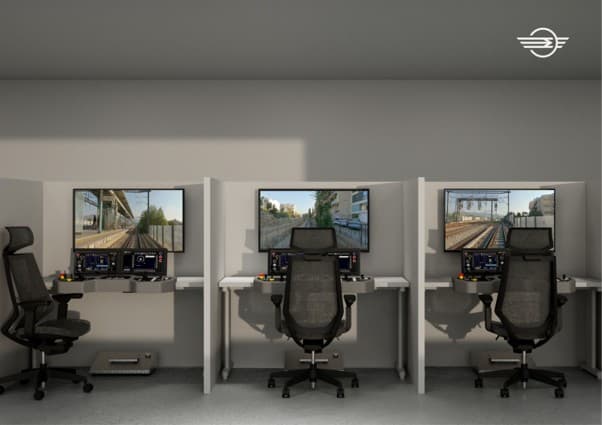
Hellenic Railways is making a significant investment in upgrading the training and operational readiness of Greek railway staff, with the signing of two contracts for the supply of a total of 14 new simulators.
The contracts cover the supply of 6 train driver training simulators, as well as 8 traffic regulation and remote control simulators for station masters.
The new simulators are expected to be delivered within 2026 and will be a key tool for upgrading the training of train drivers, station masters, traffic controllers and other safety-critical staff. They will simulate more than 500 kilometres of principal Greek railway routes, allowing training under realistic operating conditions. Through the simulators, staff will be able to train both in normal traffic scenarios and in degraded or emergency conditions, such as signals passed at danger, overspeed, unforeseen incidents on the network and ETCS operation. In this way, practical training, readiness to respond and the assessment of skills are strengthened in a safe and fully controlled environment.
The train driver training simulators will include physical traction and braking controls, high-resolution display systems, touch screens and other functions, as well as electric locomotive simulation software.
The traffic regulation and remote control simulation system will include eight trainee positions and one instructor station, making it possible to simulate an electronic interlocking system, signalling, remote control and operational traffic management scenarios.
With this investment, Hellenic Railways is establishing a new basis for more practical, repeatable and assessable training, with the aim of strengthening operational discipline, shared understanding among safety-critical disciplines and the overall safety of the Greek railway.
"For Hellenic Railways, training is not a formality. It is a fundamental pillar of safety, reliability and operational readiness. With the supply of the simulators, our staff in safety-critical disciplines will be able to train under realistic operating conditions, to test degraded operation and emergency scenarios, and to be assessed in a more systematic way.
The modernisation of the railway is not only about tracks, systems and infrastructure. It is also about the way in which we train, prepare and support the staff who keep the network running every day. That is precisely the role the new Railway Academy is intended to serve," said Christos Palios, Chief Executive Officer of Hellenic Railways
Konstantinos Kyranakis, Deputy Minister of Infrastructure and Transport, said: "Safety begins with training. From our first days at the Ministry, we set a very specific objective: that training on the Greek railway should cease to be mainly theory, paperwork and procedures, and should move to a modern and practical model, with genuine simulation of operating conditions.
The supply of the new simulators is a significant step in that direction. Train drivers, station masters and traffic staff must be able to train in all scenarios: from normal operation to signals passed at danger, overspeed, ETCS operation, degraded conditions and emergency incidents."
Related news
All news
Hellenic Railways and DYPA: 40 apprenticeship places for the new generation of railway technicians
Part A of the "Digital Transformation of Hellenic Railways" Completed – New digital services and infrastructure at 30 stations